








 Hosting & backend's built-in automatically












Historically, turning a software concept into a working application required hiring costly engineering agencies or spending months wrestling with complex, broken code repositories. The Atoms app builder directly solves this bottleneck. As a premier “prompt-to-app” platform, Atoms allows users to describe their desired application architecture in plain, natural English. The underlying AI then instantly writes the code, configures the server-side backend logic, and renders a live, working application ready for deployment.
Whether you are an independent founder testing a fast MVP, a corporate product manager needing an immediate internal tool, or a creator looking to scale an online business, the market is full of options. Let’s break down the competitive landscape. Read our full review below to see exactly why and how Atoms stands out in the highly competitive no-code, low-code, and AI generation space.
 Our top picks for June 2026
 9.8
9.8

 Easy to get started
Atoms vs. The Competition: A Head-to-Head Comparison
When searching for viable Atoms alternatives, it is critical to match the tool to your exact technical skill level and ultimate deployment goal. Here is how Atoms stacks up against its biggest market competitors when evaluating “Atoms vs” intent queries at a glance:
Atoms AI
- Best For: Rapid full-stack app generation, automated backend setup, and true deployment.
- Prompt-to-App Generation: ✅ Yes
- Code Export & Full Ownership: ✅ Yes
- Learning Curve: Low
Base44
- Best For: MVP to polished, consumer-facing mobile applications.
- Prompt-to-App Generation: ✅ Yes
- Direct to App Store Publishing: ✅ Yes
- Learning Curve: Very low
Lovable
- Best For: High-fidelity user interfaces and stunning visual aesthetics.
- Prompt-to-App Generation: ✅ Yes
- Code Export: ✅ Yes
- Learning Curve: Low
v0 by Vercel
- Best For: Raw frontend design components and visual scaffolding.
- Prompt-to-App Generation: ✅ Yes (Frontend UI only)
- Code Export: ✅ Yes
- Learning Curve: Low
Bubble
- Best For: Enterprise-grade logic and complex traditional visual layouts.
- Prompt-to-App Generation: ❌ No (Manual drag-and-drop builder)
- Code Export: ❌ No
- Learning Curve: High
The Takeaway: If you require a fully functional, production-ready application generated entirely from text prompts with zero vendor lock-in or proprietary code limits, Atoms is currently leading the pack in total velocity, code quality, and execution.
Most Recommended AI App Builders & Atoms Alternatives 2026
Deep Dive: How Atoms Compares to Specific Workflows
- Atoms vs. Lovable (The Prompt-to-App Rivals): Lovable is currently a fierce competitor in the pure AI generation space. While Atoms AI is incredibly robust for establishing a complete full-stack environment (frontend elements seamlessly paired with relational data models) off a single text prompt, Lovable leans more heavily into purely visual, pixel-perfect frontend design. If you need secure databases and rapid transactional logic deployment alongside your UI, Atoms holds the clear structural advantage.
- Atoms vs. v0 by Vercel (The UI Specialist): If you are already deeply embedded in writing your own React or Next.js code, v0 is an absolute powerhouse for spitting out beautiful, standalone UI components. However, v0 functions primarily as a frontend assistant. A true Atoms app builder experience handles the complete structural logic, allowing you to build both the user screen and the underlying system state simultaneously. This makes Atoms a far more comprehensive standalone platform.
- Atoms vs. Bubble (The No-Code Heavyweight): Bubble has been a titan of the visual development world for years. While it is highly customizable, it relies on a manual drag-and-drop canvas rather than a true AI conversational generator. Furthermore, Bubble restricts your ability to export your code, forcing your application to reside entirely on their infrastructure. Atoms generates standard, clean code that you fully own, protect, and can host anywhere you choose.
Atoms Pricing vs. Competitor Value Matrix
Don’t overpay for your deployment engine. To satisfy the exact intent behind searches for Atoms pricing, here is how Atoms’ primary tiers align with the market average for AI app builders:
- The Sandbox (Free Tier): Ideal for testing prompts, learning the chat interface, and building basic visual wireframes. Includes mandatory Atoms watermarks and branding.
- Atoms Pro ($25 – $45/mo): The sweet spot for independent entrepreneurs. Unlocks full external database connections, custom domain pairing, higher AI generation tokens, and prioritized platform support.
- Atoms Scale / Enterprise ($100+/mo): Required for production-grade applications scaling to thousands of active users. Unlocks premium dedicated database clusters, advanced security layers, and native mobile app store export tools.
Traditional visual builders like Bubble often force you into steep infrastructure pricing jumps early on, while platforms like Glide base their pricing structures on your total active user count. Atoms remains highly predictable because you pay directly for generation and computational capacity, not for how many people visit your live web application.
What to Expect: Timelines & Deployment
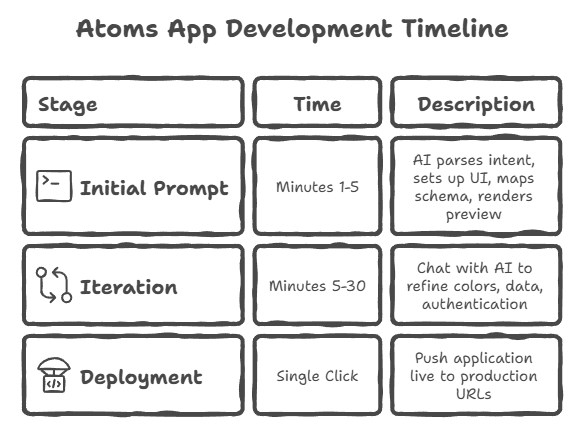
When you choose to build an app with Atoms, the timeline from initial concept to a functioning web property is completely rewritten:
- Minutes 1-5: You type your primary prompt. Atoms AI parses your intent, establishes the underlying UI framework, maps out a database schema, and renders a live, operational preview.
- Minutes 5-30: You iterate. You chat naturally with the AI assistant to refine specific colors, inject new data properties, or alter user authentication flows.
- Deploy: With a single click, you push your application live to production URLs. What used to take a technical development team months of planning now takes a single afternoon.
Potential Downsides & Side Effects
Relying entirely on any automated AI builder introduces specific operational tradeoffs you must be aware of:
- The “Black Box” Effect: Because the AI generates the code behind the scenes, non-technical founders might need to consult a specialized engineer if they want to build highly unconventional features that sit entirely outside the AI’s standard training datasets.
- Enterprise Readiness: While incredible for MVPs, typical SaaS products, and internal data dashboards, highly regulated industries (such as healthcare entities requiring strict HIPAA compliance audits) may require manual infrastructure overrides.
Buying Guide: How to Choose Your Builder
- Assess Your Project Goal: Are you building a functional SaaS tool, a client directory, or an internal business dashboard? Atoms is built perfectly for this.
- Determine Code Ownership Requirements: If you want to own your intellectual property outright and avoid severe platform lock-in, choose Atoms. If you don’t mind being trapped in a closed, closed-source ecosystem, older drag-and-drop tools will suffice.
- Test the Prompt Engines: Sign up for a free tier across multiple platforms. Type your core application concept into Atoms and a primary competitor simultaneously, then evaluate which output best fits your vision.
Our top picks for June 2026
Final Thoughts: Should You Build Your Next App With Atoms?
The landscape of modern software development has fundamentally shifted, and the Atoms AI platform is actively leading that charge. If you are an entrepreneur, small business owner, or creator looking to validate an active market idea without burning through thousands of dollars in agency fees, Atoms is the ultimate tool to defend your runway and launch fast.
While it may not instantly replace a massive, specialized engineering department for legacy systems, its ability to take you from a totally blank screen to a deployed, functional application in hours is completely unmatched.
Choose Atoms if you prioritize launch speed, want to own your exported source code completely, and need a fully functional application immediately. Stop letting the technical barrier to entry hold your business back. Start building with Atoms today.
Frequently Asked Questions
Q: Can I use my own database with the Atoms app builder?
A: Yes. Atoms allows you to connect your generated applications to highly scalable external backend databases (such as Supabase or Firebase), giving you complete control over user records and long-term data persistence.
Q: Is Atoms AI better than ChatGPT for coding applications?
A: Absolutely, when it comes to building full apps. While ChatGPT outputs text blocks and code fragments that you have to manually piece together in your local terminal, Atoms provides an integrated development environment where code is compiled, executed, and rendered as a preview-ready result.
Q: What happens if I want to leave Atoms?
A: Because Atoms generates standard, clean web framework repositories, you can easily export your project. You own the IP, meaning you can take your code straight to any hosting provider or hand it off to a traditional development team at any time.
Q: Are there hidden costs in Atoms pricing?
A: No. Atoms offers transparent subscription structures. The only additional costs you will incur are standard third-party services as you scale (such as purchasing a custom domain name from a registrar or upgrading external database tiers as your user base expands).
Q: Is there an active discount code or annual saving for Atoms pricing?
A: Like most competitive no-code AI platforms, Atoms provides a 15% to 20% discount if you switch from month-to-month billing to an annual subscription plan. Check their official billing dashboard for active seasonal promotions.
Q: Can Atoms build both web applications and native iOS/Android mobile apps?
A: Yes. While the Atoms app builder compiles web frameworks perfectly optimized for mobile browsers out of the box, its premium tiers provide the tools to package your code repository for native wrapper deployment to the Apple App Store and Google Play Store.
Q: Why should I look at Atoms alternatives if Atoms AI is highly rated?
A: No single tool handles every software project perfectly. While Atoms is an elite choice for full-stack prompt generation and clean code export, an alternative like Lovable might suit you better if you need hyper-focused component aesthetics, while a tool like Base44 might be better for an absolute beginner looking for direct-to-app-store publishing.
