





 Agents for every team, workflow & department






The gap between AI excitement and real-world implementation is massive. Companies want to adopt AI, but many teams still struggle to keep up with the modern pace of work. An AI agent bridges this gap. Unlike a standard chatbot that simply waits for your prompt, an intelligent virtual agent is an autonomous, goal-oriented digital worker.
When you use a low-code AI agent builder like monday.com’s, you solve the problem of fragmented workflows, turning them into unified, intelligent systems. This allows your human workforce to ship more, decide faster, and compound your ROI.
 Our top picks for June 2026
 9.8
9.8

 Any agent for any use case
Types of Agents & Top Brand Names
When deciding how to build your own AI agent, it helps to understand the landscape. For general use cases, we recommend monday.com. That being said, the market features several standout platforms tailored to different operational needs:
Enterprise & Workflow Agents
For orchestrating complex, multi-step business logic, platforms that support an n8n AI agent or a collaborative CrewAI agent setup are incredibly popular. If you are an agency, you might even look for a white-label AI agent solution to rebrand and offer to clients.
Specialized Core Models
Many users want to natively harness ChatGPT workflows and look for an open AI agent builder or a direct agent builder open AI integration. Alternatively, a Claude AI agent excels at deep textual reasoning, while an Anthropic agent ensures safe, aligned responses.
Coding, Research & Admin
If your team writes software, specialized AI coders like the Devin AI agent or Replit AI agent are revolutionizing development. For administrative routing, an enterprise-configured Lindy AI agent is unparalleled.

Top-Rated AI Agent Builders Of 2026
Here are some of the most trusted and best general-use AI agent builder platforms available today:
What to Expect: Building Your AI Agent from Scratch
The timeline to deploy an intelligent system is faster than ever. You no longer need to be a developer to make an AI agent.
- Define the Goal (Minutes): Use plain English to tell the platform what you want. If you want to know how to build an AI agent for repetitive data entry, simply type your requirements into the visual interface to build an AI agent no code.
- Set the Context (Hours): Creating AI agents requires context. The best platforms provide a shared space where people and agents move work forward together, giving your agent access to cross-departmental data.
- Simulation & Launch (Days): Design AI agent workflows and run them in simulation mode to ensure the logic is sound. Once validated, deploy your new digital worker.
Potential Downsides & The Importance of Trust
The biggest roadblock to adopting AI is fear. People fear AI operating in a “black box,” and organizations worry about data security. It is critical to choose a platform that offers enterprise-grade trust.
To mitigate risks, ensure your platform includes a “human in the loop” feature. You must be able to validate your agents’ actions before activating them. Furthermore, look for explicit permission controls, HIPAA compliance, SOC 2 Type II certification, and a strict policy that prevents third parties from training on your private data.
Cost & Pricing Analysis
Finding the best value depends on your scale and needs.
- Free and Low-Cost Options: If you are just experimenting and want to create your own ai agent, you can easily find free tiers or use trial credits. A free tier is perfect for simple, single-step tasks or when acting as a builder first ai agent test.
- Business/Enterprise Tiers: For cross-department context, you will typically pay per user or per workflow execution. Investing in a unified AI Work Platform (where CRM, PMO, and IT data already live) is often much more cost-effective than buying disparate, siloed tools that require expensive consultants.
Buying Guide: How to Choose the Right AI Agent Builder
When you are ready to create AI agents, follow these steps to find the perfect fit:
- Check for Cross-Department Context: AI is only as powerful as the context it can access. Choose a platform with a structured data layer across departments so your agent can pull insights organization-wide.
- Evaluate Ease of Adoption: Look for the best AI agent builder that integrates seamlessly with your team’s existing workflow. You want to create an AI agent without coding, avoiding heavy implementations and steep learning curves.
- Prioritize Action Over Text: Avoid platforms that just summarize text. You want a no-code AI agent tool that can actively update databases, trigger webhooks, and automatically send reports.
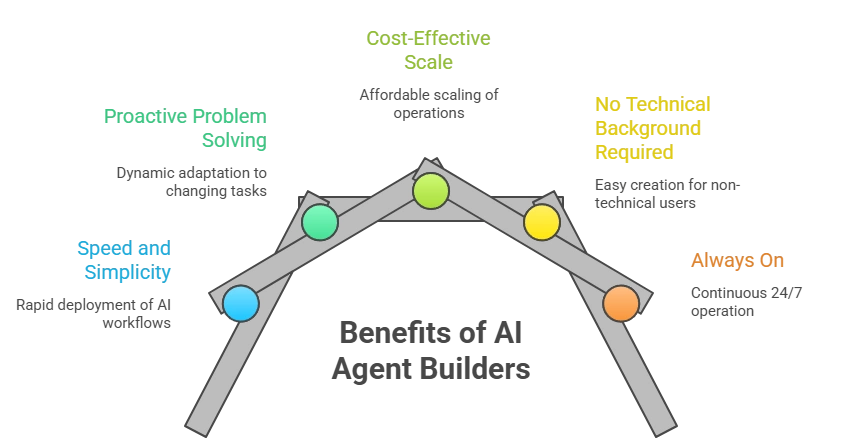
Final Thoughts: Where Ambition Meets Execution
Adopting AI shouldn’t mean facing a steep learning curve, hiring expensive consultants, or losing control over your company data. The true power of modern automation lies in collaboration—giving your human team the advanced tools they need to succeed without the busy work.
By choosing the best platform to build AI agents for your business, you aren’t just buying software; you are onboarding a digital teammate. Start small, keep a human in the loop to build trust, and watch as your new autonomous systems transform the way you work.
Our top picks for June 2026
Frequently Asked Questions
Q. What is the difference between a chatbot and an AI agent?
A. A chatbot is conversational and waits for your prompt to answer a question. An AI agent is autonomous and action-oriented. It can proactively monitor systems, log into software, and execute multi-step tasks without needing constant supervision.
Q. How do I build an AI agent if I don’t know how to code?
A. Modern platforms are designed for everyday users. You can create your own AI agent workflows using visual drag-and-drop interfaces or natural language prompts (telling the AI what to build in plain English).
Q. How much does it cost to build an AI agent?
A. It varies widely. You can find a free platform for simple automations. However, enterprise-grade platforms that manage complex, multi-agent systems across an entire company typically charge a monthly subscription fee per user or per execution credit.
Q. What tools are best for creating AI agents from the ground up?
A. When figuring out how to build an AI agent from scratch, it helps to test multiple platforms.
- If you are exploring how do you build an AI agent for coding, a Devin agent, Replit agent, or emergent.sh agent might be best.
- If you want to make an AI agent for complex team scheduling or administrative routing, an enterprise-configured Lindy agent is ideal.
- From an Auto GPT agent and n8n agent to a GenSpark agent and Crew AI agent, the market is exploding. Whether you are creating AI agents for the first time, wondering how to build a AI agent for complex tasks, or simply looking for an AI agent builder free trial to create your own AI agent, our comparison list above will point you in the right direction.
Q. What is the difference between traditional workflow automation and an AI agent?
A. Traditional automation uses rigid, hard-coded “if/then” rules. If a single variable changes or a link breaks, the entire workflow stops. An AI agent is dynamic and goal-oriented. Using large language models (like a ChatGPT agent or Claude AI agent), it understands the overarching objective. If it encounters a roadblock, it can reason through the problem, find a workaround, or ask a human for clarification rather than just failing.
Q. What is a multi-agent system?
A. A multi-agent system or framework (commonly built using tools like a CrewAI agent or an Auto GPT agent setup) is a network where several specialized AI agents collaborate to complete a massive project. For example, a “Research Agent” might gather competitor data from the web, hand that data to an “Analysis Agent” for processing, who then passes the insights to a “Reporting Agent” to format a PDF for the executive team.
Q. How long does it take to deploy an enterprise AI agent?
A. With a modern, no-code AI agent builder, the barrier to entry is extremely low. You can build an AI agent from scratch for a single task in a matter of hours. For complex, cross-departmental agents that require deep integrations with your CRM and databases, deployment typically takes a few days to a few weeks to properly map data permissions and run “human in the loop” simulations.
