

Can I Monetize a Free AI-Generated App? The Blueprint for Recurring Revenue
Daniel Zvi

AI App Monetization is the strategic process of converting free users into paying customers by restricting access to advanced features, usage limits (tokens), or exclusive content within a No-Code application. The main benefit is creating a Recurring Revenue (SaaS) stream rather than a one-time payment.
Unlike a standard e-commerce store where you sell a physical shirt, AI apps often sell "Compute Power" or "Intelligence." This requires a completely different technical setup. You aren't just processing a credit card; you are tracking how many words the AI generated for that specific user and billing them accordingly.
The "Who Pays?" Problem in AI
Before you try to make money, you must understand the "Unit Economics" of AI.
In traditional software, if 1,000 users use your app, your costs stay mostly the same. In AI, usage = money. Every time a user asks your app a question, OpenAI or Anthropic charges a small fee (a fraction of a cent per "token").
- The Trap: If you build a free tool that goes viral, you could wake up to a $5,000 bill from OpenAI.
- The Fix: You must choose a business model that passes this cost to the user.
 Our top picks for April 2026
 9.8
9.8


 Ready to use, instantly

The Hidden Costs of Monetizing AI
Many builders fail because they look at revenue but ignore the "Unit Economics" of AI.
- The "API Tax": Every time a user asks your free app a question, you pay OpenAI or Anthropic. If you don't monetize correctly, your "Free Users" will bankrupt you.
- Platform Fees: Some "Free" app builders take a 2% to 10% transaction fee on every sale you make, on top of Stripe's fees.
- The 30% App Store Cut: If you wrap your app for iOS, Apple takes 30%. You need a web-based monetization strategy (PWA) to keep your margins.
How do I Monetize My App? (2 Proven Models)
Model 1: The SaaS Route (Recurring Revenue)
Best for: Building a long-term business where you control the users.
In this model, you host the app. Users log in to your domain (e.g., MyCoolCRM.com) and pay you a monthly fee. You pay the API bill.
1. The "Token" System (Pay-As-You-Go)
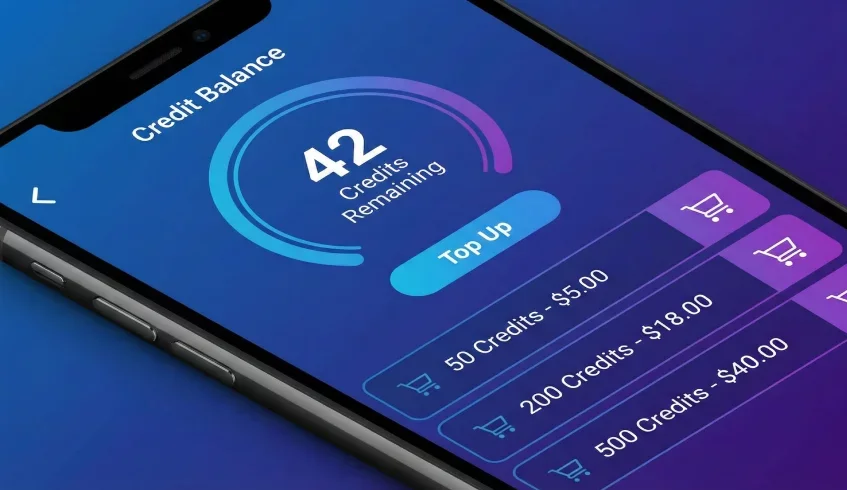
The safest way to monetize is to sell "Credits." This protects your margins against heavy usage.
- The Logic: "Buy 50 AI Credits for $5.00."
- The Math: If 50 credits cost you $0.50 in API fees, you keep $4.50 as profit.
- The Tech: You need a builder like Base44 that can track exactly how many times a user clicks "Generate."
2. The Subscription (Freemium)
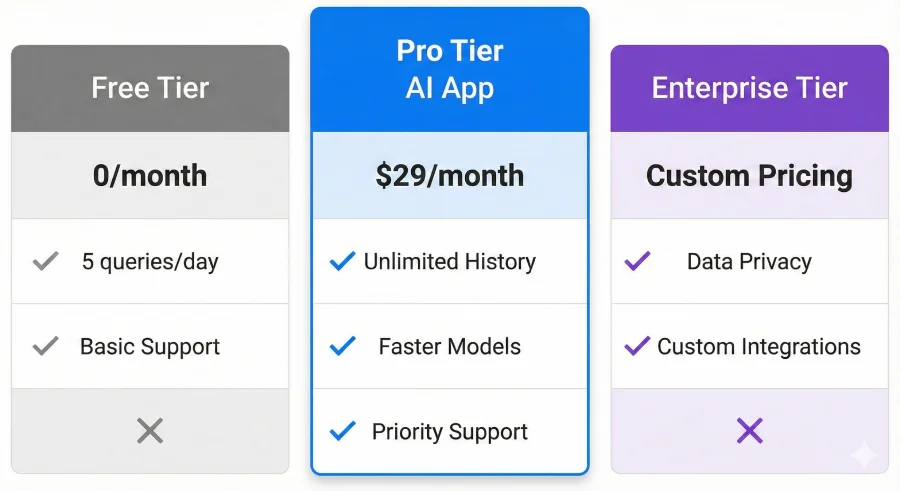
- Free Tier: Users get 5 queries/day (you eat this cost as marketing).
- Pro Tier: $29/month for unlimited usage.
- Safety Cap: Even on "Unlimited" plans, you must set a backend limit (e.g., 500 queries/month) to prevent abuse.
Model 2: The Template Route (One-Time Sales)
Best for: "Vibe Coding" & Passive Income without technical headaches.
This is what you described: "Making an app and selling it." In the industry, this is called selling templates or whitelabeling.
How it works:
- You use Base44 to build a perfect "Real Estate CRM."
- Instead of hosting it yourself, you export the "Project File" or "Template Link."
- You sell that link on a marketplace (like Gumroad or the Base44 Marketplace) for $100.
- The Critical Difference: The buyer imports the app into their account and adds their own OpenAI API Key.
- Result: You get $100 profit. They pay for their own usage. You have zero monthly costs.
Learn more in our guide: How to Sell AI Templates & Make Money with Vibe Coding
What tools or "Tech Stack" do I need?
To handle these models, you need tools that understand application logic, not just design.
- For SaaS (Subscriptions):
- Stripe: The standard for payments.
- Base44: The only no-code builder with native "Credit Deduction" logic. It can lock a button if a user’s credit balance is zero.
- For Templates (One-Time Sales):
- Gumroad / Lemon Squeezy: Perfect for selling digital files (the template link).
- Base44 Marketplace: Allows you to list your app so other users can clone it with one click.
What are the advanced mistakes to avoid?
- Offering "Unlimited" AI for a Flat Rate This is the fastest way to kill your business. If you charge $10/month for "Unlimited AI Writing," a single "Power User" might generate $50 worth of API costs, putting you in the red. Always implement "Fair Use Limits" or caps, even on paid plans.
- Using "Standard" Builders for SaaS Tools like Wix is fantastic for building online stores or portfolios. However, they struggle with Application Logic. They don't easily allow you to say, "Deduct 1 credit from User X because they clicked this button." You end up using complex workarounds that break easily.
- Ignoring Churn Metrics You must track how many users cancel. If your "Churn Rate" is over 10%, your product has a quality issue, not a pricing issue.
Can software automate Monetization?
Setting up a "Credit System" manually requires writing complex code to track API usage and sync it with Stripe webhooks.
While standard builders allow you to put up a simple "Buy Now" button, they rarely offer deep integration with AI usage tracking.
This is where Base44 stands out for AI entrepreneurs.
Base44 is designed specifically for building SaaS products, not just websites. It automates the monetization logic:
- Native "Credit" Logic: Base44 has built-in systems to track user activity (clicks, generations) and deduct credits automatically. You don't need to code the math.
- Stripe Integration: It offers deep integration where user roles change automatically upon payment failure or success.
- Template Marketplace: As mentioned in our Vibe Coding Guide, Base44 is one of the few platforms that allows you to easily package and sell your apps as templates to others.
Our top picks for April 2026
FAQs: Making Money with AI
Q: Can I use Stripe with any app builder?
A: Most builders allow a basic "Checkout" button. However, only advanced builders like Base44 allow "Two-Way Sync," where Stripe tells the app to unlock features immediately after payment.
Q: How much should I charge for my AI app?
A: A common B2B price point is $29-$49/month. For B2C (consumers), it is usually $9.99/month. Always price based on the value of the time you save the user, not just your costs.
Q: What is "Vibe Coding"?
A: It's the modern approach to development where you use natural language (AI) to build apps rather than writing syntax. You can monetize this skill by selling the resulting templates.
Q: Is it better to sell subscriptions or one-time access?
A: For AI usage, subscriptions are safer because they cover your recurring API costs. However, for selling templates, one-time payments are the standard.
Q: Which model is more profitable?
A: SaaS has a higher ceiling (recurring income grows forever), but it is harder to manage (customer support, bugs, API bills). Templates are easier to start (sell once, forget it), but you constantly need to find new buyers.
Q: Do I need to be a coder to sell templates?
A: No. With "Vibe Coding," you just describe the app to the AI builder, tweak the design, and sell the result.
Q: Can I do both?
A: Yes. Many creators build a SaaS app, run it for a while, and then sell the "Template Version" to people who want to host it themselves.
Liked this article?
Daniel Zvi
Smart Recommendations


Thank you!